
When to get mehndi done before Diwali UK: the two-day rule
Natural henna takes about two days to reach its darkest brown, so the day you apply it matters more than the festival date. Here is how to read the stain as it develops, plus the day-by-day countdown for Diwali 2026.
We earn commission from qualifying Amazon purchases. It costs you nothing and does not affect what we recommend.
Quick answer
Get mehndi done one to two days before the day you want it darkest. For Diwali on Sunday 8 November 2026 that means the evening of Friday 6 or Saturday 7 November. To be dark from Dhanteras on the 5th through to Bhai Dooj on the 10th, apply on the 4th or 5th instead. The colour of the stain, not the calendar, tells you it is ready.
Working out when to get mehndi done before Diwali in the UK comes down to one fact about natural henna: it does not reach its true colour on the day it goes on. The stain keeps darkening for about two days afterwards. Book too early and the design is fading by the time the diyas are lit; book too late and you are handing round mithai with orange palms. Wedding guides have a mehndi night that fixes the timing for you; Diwali does not, so this page gives you the signals to read on your own skin and a countdown for 2026.
Dates first. Diwali 2026, meaning Lakshmi Puja, falls on Sunday 8 November. Dhanteras is Thursday 5 November, Naraka Chaturdashi or Choti Diwali is Saturday 7 November, and Bhai Dooj is Tuesday 10 November. Panchang localisation can shift a tithi by a day, so check the calendar your family follows and slide the countdown by a day if it differs.
Reading the stain: what henna looks like at each stage
The paste on the skin
Fresh, natural henna paste is khaki to dark green-brown, never jet black, and smells of the essential oils mixed into it: eucalyptus, cajeput, lavender or tea tree, with an earthy, hay-like note underneath. It goes on glossy, turns matte within 20 to 30 minutes, and after an hour or two the thicker lines start to crack at the edges, which is your cue to seal it.
The first hours after removal
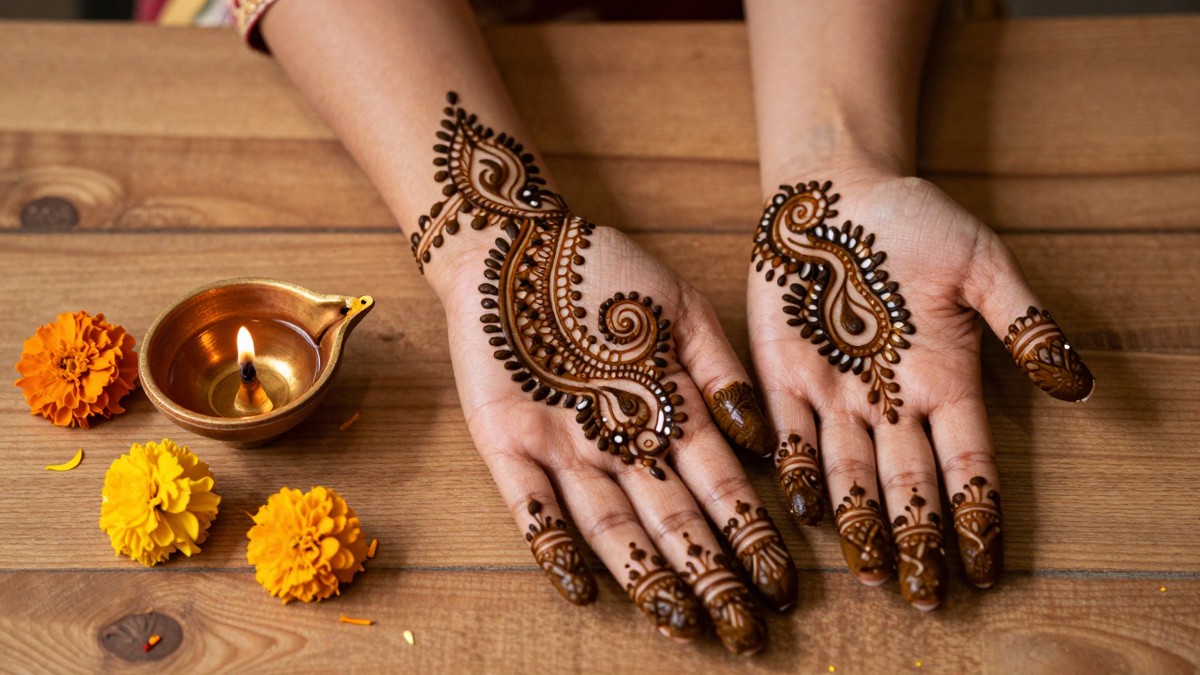
When the dried paste is scraped away, the stain underneath is bright orange, somewhere between apricot and tangerine. That is normal. What you are checking is coverage: every line should be clearly orange with no faint sections. If the stain is barely yellow, the paste came off too soon, the skin had lotion on it, or the paste was old.
Day one to day three
Over the next 24 hours the orange deepens to terracotta and then reddish-brown. By 48 hours the palms and fingertips, where the skin is thickest, are a deep brown or mahogany; the backs of the hands stay a shade or two lighter. Peak colour lands between day two and day three. A quick test: hold your palm next to the back of your hand at the 24-hour mark. If the palm is still terracotta rather than brown, it has another day of development in it.
The fade
Full colour holds for around a week. After that the stain lightens as the outer layer of skin sheds, taking one to three weeks to disappear depending on how often the hands are in water. Palms go first, backs of hands last.
 Featured
15% OFF*Limited offer
One Sunday. A week of food, sorted.
23 high-protein recipes, cycle-synced for women who lift.
23 recipes · 60-page PDF · Instant download
£19.20 £16.32
See it on Etsy*Seller's discount on Etsy - may end at any time.
The countdown from late October
The dates below are for Diwali on 8 November 2026. If your calendar puts it on the 7th, move everything forward by a day.
Week of 19 October
Nothing goes on the skin yet. This is the week to book an artist, because the good ones fill their Diwali fortnight early. If you are using a shop-bought cone, order it now so it arrives in time for a patch test. Decide which days matter most: only the evening puja on the 8th, or the whole run from Dhanteras to Bhai Dooj.
Week of 26 October
Still too early: a stain from this week will be halfway faded by the 8th. Use the days for hand care instead, buffing away dry skin and moisturising daily, because you will have to stop 24 hours before the appointment.
Monday 2 and Tuesday 3 November
Patch test any bought cone by Tuesday at the latest. Stop hand cream, body oil and sunscreen from Tuesday if you are applying on Wednesday.
Wednesday 4 and Thursday 5 November, Dhanteras
The window for people who want dark hands across all five days. Apply on the 4th and the stain is orange on Dhanteras morning, reddish-brown that evening, at its peak on the 6th and 7th, still deep on Diwali and only beginning to soften by Bhai Dooj. Apply on the 5th and Dhanteras is orange but everything from Choti Diwali onward is strong. We would choose the 4th.
Friday 6 November
The best single day for a Diwali-only stain. Apply in the evening, sleep with the paste on, scrape it off on Saturday morning and let the colour build through the weekend. By the time the lamps go on for Lakshmi Puja it is close to its darkest.
Saturday 7 November, Choti Diwali
The last sensible day, and the busiest for artists. Apply in the morning, keep the paste on until early evening, and it will be a solid reddish-brown by Sunday evening: not quite peak, but a long way from orange, and at full depth by Bhai Dooj.
Sunday 8 November, Diwali
Too late to apply if you want colour tonight; an early-morning application gives a warm orange-brown by the evening at best. Otherwise keep the stain warm, dry and away from soap.
Monday 9 and Tuesday 10 November, Bhai Dooj
A stain applied on the 6th or 7th is at its peak. From here the countdown becomes the fade through the second half of November.
Getting the darkest stain from one application
Prepare the skin. Wash your hands with plain soap immediately before the appointment and dry them well. No hand cream, oil, sunscreen or perfume on the area for the previous 24 hours: any film on the skin blocks the dye. Warm hands take colour better, so hold a warm mug for ten minutes first if you have walked in from the cold.
Let the paste dry undisturbed. Keep the hands still and flat for 20 to 30 minutes until the surface is matte, somewhere warm. A cold room slows the dye release and a humid one keeps the paste tacky.
Seal it. Once the paste is dry and starting to crack, dab a lemon-sugar solution over it with cotton wool: a squeeze of lemon and a teaspoon of sugar in a couple of tablespoons of water. Two or three light applications over the next few hours keep the paste stuck to the skin. Do not drench it, or the lines run.
Keep it on as long as you can. Four hours is the minimum, six to eight is better and overnight is best. To sleep with it on, wrap each hand in tissue and then a loose cotton glove rather than cling film, which traps sweat and lifts the paste. The cotton moisturising gloves we reviewed are the right kind of thing.
Remove it dry. Scrape or flake the paste off with a blunt edge, then wipe the residue with a little oil on a tissue. No water for the first 12 hours, ideally 24. Washing early stops the stain at orange.
Warm the stain. Heat in the first day makes a visible difference. Hold the hands near a radiator, wear gloves indoors, or hold them over a pan of steaming water with a few cloves in it, the traditional method. Before washing up, put a barrier of balm or oil on first. From day two onward, go back to a rich hand cream such as O'Keeffe's Working Hands to slow the fade, because well-moisturised skin sheds more slowly.
What goes wrong and how to recover
Pale stain. Usually lotion residue, cold skin, paste removed too early, or a cone that has sat in a warm cupboard for months. Recovery: reapply the following day over the same lines. A second layer on a faint stain deepens it noticeably, which is why applying on the 6th leaves you a repair day before Diwali.
Patchy stain. The paste lifted in places, usually from sweating under a wrap or bending the fingers before it was dry. Recovery: touch up the missing sections with a cone the next morning and keep the hands flat this time.
Stuck at orange. The hands went into water within hours of removal. Recovery: keep them warm and dry for the rest of the day and the colour may still deepen, just not to full mahogany.
So-called black henna. This is the one that matters. Natural henna is never black. Products sold as black henna contain para-phenylenediamine, PPD, a hair dye chemical not permitted on skin in the UK. It can cause blistering, chemical burns and permanent scarring, sometimes days after application, and can leave you sensitised to PPD for life so that hair dye later triggers a serious reaction. The warning signs are jet-black paste, a chemical rather than herbal smell, and a promise of a black stain within an hour. If you have used one and the skin is burning, itching or blistering, wash it off, see a pharmacist or GP, and call NHS 111 if the burn is spreading.
Allergic reaction to a natural cone. Rare, but essential-oil blends can irritate sensitive skin. Patch test every shop-bought cone 48 to 72 hours before the real application: a small dot on the inner forearm, left on for a few hours, then watched for two days. If it itches or swells, book an artist who mixes their own paste instead.
Booking an artist in the UK
Demand for mehndi artists in the UK runs in one steep fortnight before Diwali. In Leicester around Belgrave Road, in London around Southall, Wembley and Tooting, and in Birmingham around Soho Road, the evenings of Friday 6 and Saturday 7 November 2026 will be the first slots to go. Book in the week of 19 October and ask for the evening before the day you care about most.
The weather works against you. Early November hands are cold, and cold skin stains lighter and slower. Wear gloves on the way to the appointment, keep them on over the wrap on the way home, and give the stain a warm first day indoors.
Think about work as well. A palm design applied on the 6th is visible in the office through the following week and faint for another week or two after that. If that is a problem, a forearm design sits under a sleeve. One more timing point: many families do an oil bath on Naraka Chaturdashi, so read our guide to when to do an oil bath before Diwali in the UK and do the bath before the mehndi appointment, not after it, because oil on the skin blocks the stain.
Frequently asked questions
How long does mehndi take to go dark?
Natural henna reaches its darkest colour about 48 hours after the paste comes off. It looks orange on the first day, reddish-brown by the second and deep brown by day two or three, with the palms and fingertips darkest of all. Warmth speeds the change up and cold slows it down.
Can I get mehndi done on Diwali day itself?
You can, but it will still be orange during the evening puja. If that is the only slot available, have it applied in the morning, leave the paste on until late afternoon and accept that it peaks two days later for Bhai Dooj. The evening before is a much better booking.
How long does a mehndi stain last?
Expect the deep colour to hold for roughly a week, then fade over one to three weeks as the skin renews itself. Palms fade fastest because they are washed most, so a design applied on 6 November is usually gone from the palms by the end of the month.
Is a henna cone bought online safe to use?
Only if it is natural henna and you patch test it first. Squeeze a small dot on the inner forearm 48 to 72 hours before Diwali and check for itching, redness or swelling. A cone that promises a black stain in under an hour almost certainly contains PPD and should not go near your skin.
Should I moisturise my hands before mehndi?
No. Stop hand cream, body oil and sunscreen 24 hours before your appointment, because any film on the skin blocks the dye from binding. Moisturise well in the week before instead, then wash with plain soap just before the paste goes on.