
Prep & Flow Cycle Syncing Cookbook Review: Honest Enough to Debunk Itself
We earn commission from qualifying Amazon purchases. It costs you nothing and does not affect what we recommend.
Most cycle syncing content is invented, and this cookbook admits it on page three. We read all 60 pages of Prep & Flow to see whether the honesty survives contact with the recipes.
- What the Prep & Flow cycle syncing cookbook actually is
- How the four phases and the Sunday System work
- The recipes, and the numbers behind them
- The honest bit is its best feature
- Where the cookbook falls short
- Who it is for, and who should skip it
- Cycle syncing questions, answered
- The verdict: is a cycle syncing meal prep cookbook worth it?
Disclosure: the cookbook's seller gave us a free copy to review. We were not paid, and the verdict below is our own.
Open almost any cycle syncing cookbook and you get the same promise: eat these foods in this phase and your hormones fall into line. Prep & Flow opens by calling that idea what it is. Page three is titled "The honest bit (read this first)", and it says plainly that a lot of what gets said about cycle syncing is invented. That is a strange way to sell a cycle syncing cookbook, and it is exactly why this one is worth a proper look.
So we read the whole thing, all 60 pages, cover to closing essay. This is a review of what is actually on those pages: the four-phase system, the Sunday batch-cook method, 23 high-protein recipes with the numbers to back them, and the flaws the sales page skips over. If you want the short version, the honest answer to "is it any good" needs the full picture, but you can already see the current price on Etsy, now 15% off* £19.20 £16.32.
What the Prep & Flow cycle syncing cookbook actually is
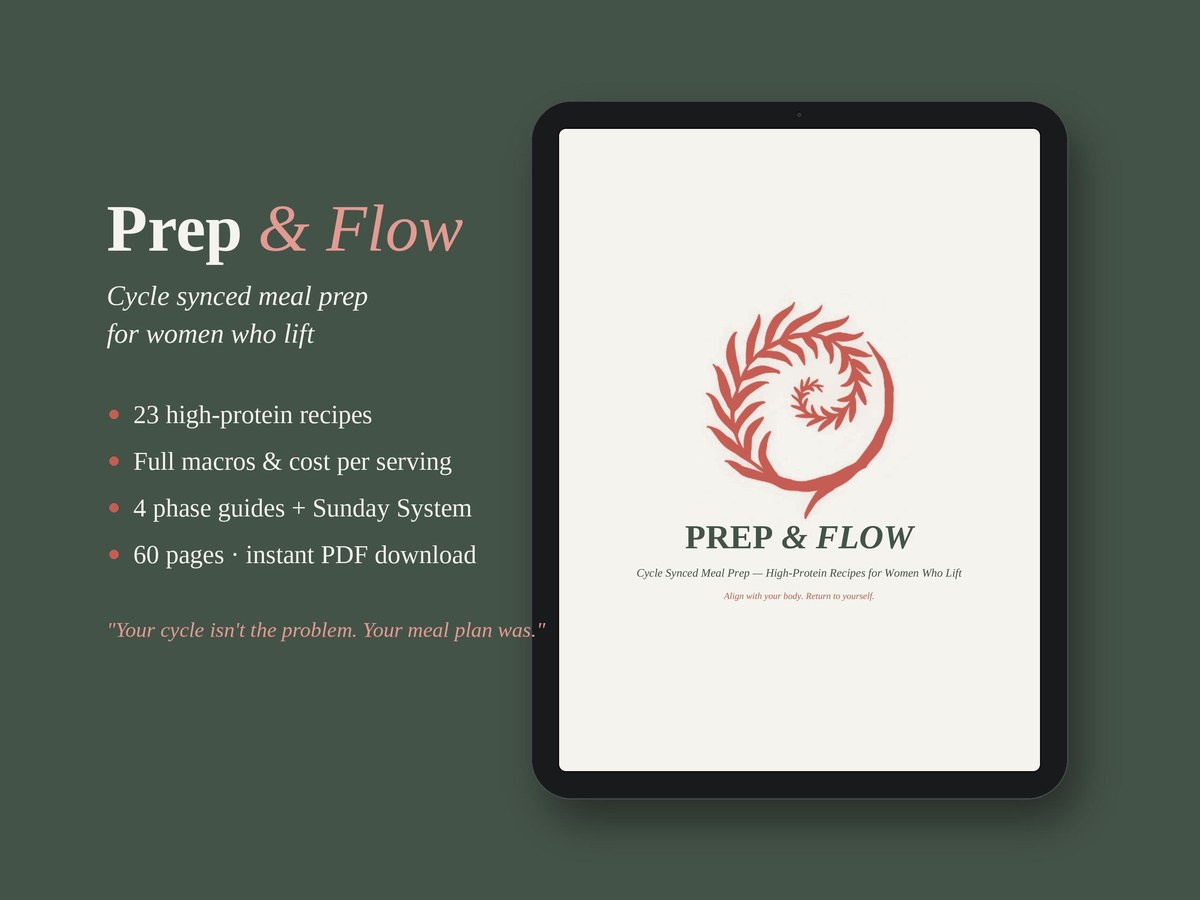
Prep & Flow is a downloadable cycle syncing meal plan PDF, not a printed book. You pay once, get an instant 60-page A4 file, and read it on a phone, a tablet or a printout. The tagline is "Align with your body. Return to yourself," and the pitch is narrow on purpose: high-protein, batch-cooked food for women who strength-train, arranged so the plan flexes with your cycle instead of fighting it.
Inside there are 23 recipes split into six breakfasts, nine batch mains, two "fresh cook" dinners and six snacks and sweets, plus four phase guides, a Sunday prep method, one shopping list, a pantry list and a herb cheat sheet. Every main recipe is meant to carry a coloured strip with calories, protein, carbs, fat and a cost per serving, and most of them land between roughly £1.50 and £3.20 a portion. That combination, both high in protein and properly cheap, is the thing that separates it from the free cycle syncing recipe books floating around Pinterest, which almost never cost anything out.
The writing sets the tone early. It is warm, funny and firmly anti-diet-culture: no 1,200-calorie plans, no "hormone-balancing superfoods", no lists of forbidden ingredients. The author's pitch is that she wrote it because everything else out there was "either bro-food or a starvation plan", and the whole book keeps that middle line.
How the four phases and the Sunday System work
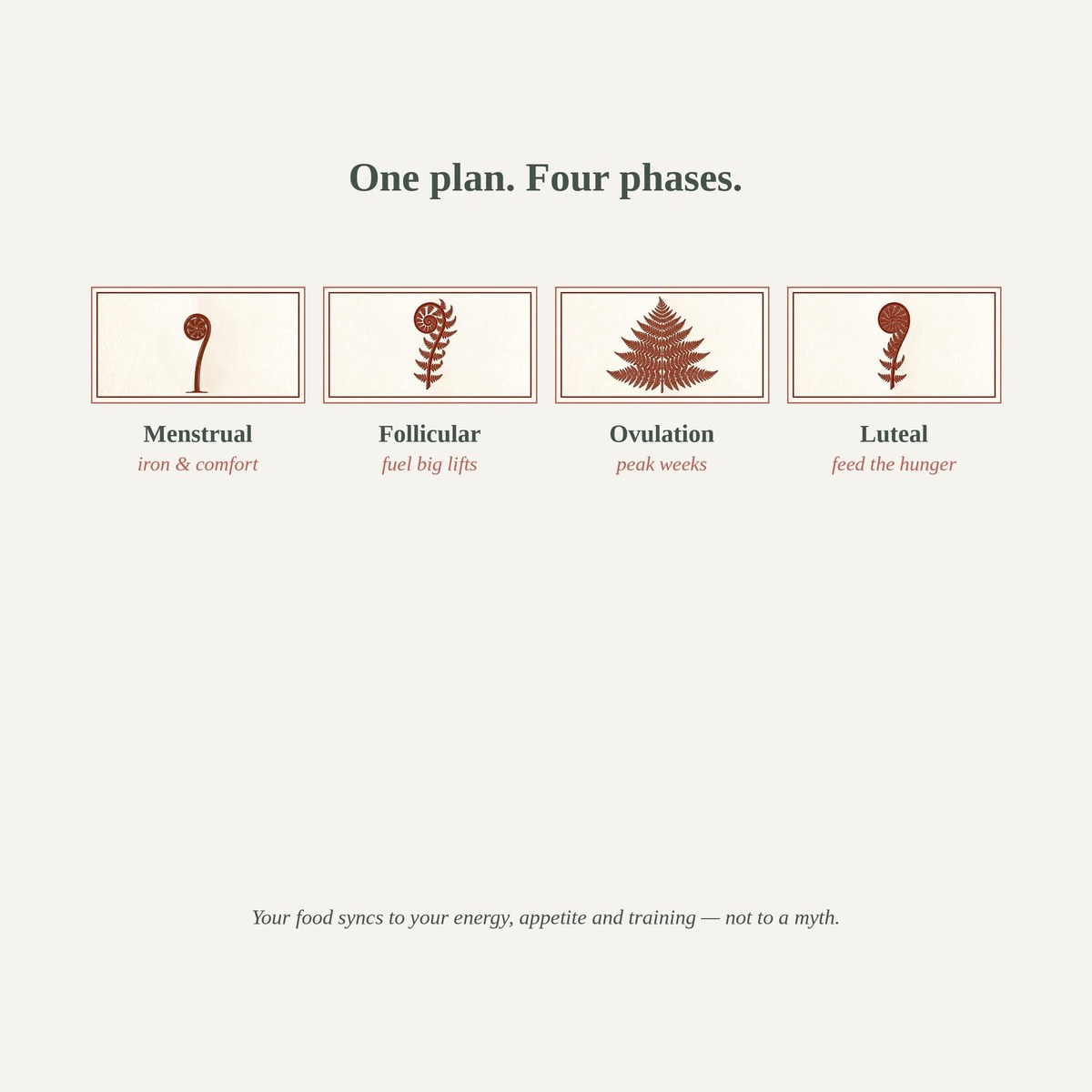
The backbone of the book is a simple idea, stated up front: the core of every week stays the same, high protein and real food, and only the frame around it flexes. The recipes are not locked to phases. Instead there are four short playbooks that tell you how to lean the same recipes in different directions.
Each of the four phases, menstrual, follicular, ovulation and luteal, gets its own short playbook. The menstrual and luteal weeks are where the idea earns its keep: the book leans one week towards iron-rich comfort food and the other towards simply eating a little more when appetite climbs, instead of treating the extra hunger as a discipline problem. The follicular and ovulation weeks get lighter treatment, nudging you towards your bigger training sessions and quicker meals. None of it is prescriptive, and the point is repeated often: the core recipes stay the same all month, and the playbooks only change which ones you reach for and how much you eat. The signature line, aimed at that hungrier luteal week, is "Eating a bit more now isn't falling off track. It IS the track."
The other half of the method is the Sunday System, a single batch-cook session the book times at about 90 minutes. It is laid out as an order of operations so that several dishes overlap rather than being cooked one after another, with a firm rule about cooling everything properly before it goes in the fridge. Do that with two or three mains plus a breakfast and a snack and you come out with 15 to 20-plus portions for the week. In practice a full batch with proper cooling is closer to 90 to 120 minutes unless you are well drilled, so treat the 90-minute figure as the best case rather than a promise.
The recipes, and the numbers behind them
This is where a high protein cycle syncing meal plan lives or dies, and mostly it delivers. The headline example is the Tuna Pasta Bake, which lands at 38g of protein a serving for about £1.50 and which the book fairly nicknames "the £1.50 workhorse". That is the pattern across the batch mains: genuinely high protein at a price that reads like a student budget, which is the real thing separating this from the free phase-by-phase recipe lists floating around Pinterest.
The range runs from that everyday value up to the odd deliberate splurge, such as a £6.50 Steak Night the book flags as aspirational rather than a Tuesday staple. Breakfasts and snacks pull their weight too, and the one most people will actually make is a Chocolate Protein Mug Cake at 20g of protein for around 60p in a couple of minutes. Most of the mains carry a coloured strip listing calories, protein, carbs, fat and a cost per serving, so you can see what you are getting before you commit to a shop, and the numbers that are there hold up to scrutiny.
On the recurring "what should you eat in your luteal phase to build muscle" question, the book's answer is refreshingly boring: keep protein high, allow yourself a bit more food on the hungrier days, and do not overthink the rest. No miracle foods, just slightly more of the same. If you want to see the full recipe line-up before deciding, it is all listed on the Etsy listing, now 15% off* £19.20 £16.32.
Prep & Flow: Cycle Syncing Meal Prep Cookbook
23 high-protein recipes, four phase playbooks and the Sunday System as an instant 60-page PDF. The seller's 15% discount brings it to £16.32, down from £19.20, at the time of writing.
The honest bit is its best feature
Most cookbooks in this corner of the internet sell certainty. Prep & Flow sells the opposite, and it is the best decision in the whole file. Its page-three opener, titled "The honest bit (read this first)", tells you plainly that much of what gets said about cycle syncing is invented, then draws a clear line between what the evidence supports and what it does not.
On the supported side it sticks to defensible ground: appetite and energy use rise modestly in the luteal week, iron needs are higher around menstruation, and magnesium may take the edge off PMS. On the unsupported side it is blunt, calling the idea that specific foods "balance your hormones" by phase "marketing, not physiology". It tells you to treat the phases as a starting point rather than a rulebook, and backs that up with a medical disclaimer more than once and a lot of careful hedging.
For a genre stuffed with pseudoscience, that restraint is rare and genuinely reassuring. What you are buying is a sensible high-protein batch-cooking habit with a cycle-aware frame, not a hormonal cure, and the book is honest enough to say so itself. It quietly answers the sceptic's questions along the way: the parts of cycle syncing that are real are small and well evidenced, and it only leans on those.
Where the cookbook falls short
An honest review of an honest book still has to point at the seams, and there are a few.
Start with the macros, because they are the reason a lot of people will buy this. Page four promises full macros and a cost for every recipe, but five of the 23 do not have them: the Chicken Fajita Bowls, Chicken Shawarma Bowls, Sticky Tofu and Broccoli Stir-Fry, High-Protein Hot Chocolate and the Cottage Cheese "Cheesecake" Pots. It looks like a layout casualty rather than laziness, but if you bought the book specifically for the numbers, that is a real gap on roughly a fifth of the recipes.
The page count is padded, too. Around nine pages are blank except for a logo watermark, and a few more are near-empty tip overflows, so the real content is closer to 40 to 45 pages. It is still good value, but "60 pages" oversells it.
A few of the "recipes" are really assembly jobs. The Greek Yoghurt Power Bowls, the Hot Chocolate and the Savoury Snack Box are closer to serving suggestions than recipes, and the book cheerfully admits the snack box is "a shopping list wearing a recipe costume". That is charming, but it pads the "23 recipes" headline by about four.
Then there are the images. Only six of the 23 recipes have a picture at all, and the ones that exist are AI illustrations rather than photography. The section dividers wander off-brief into a Norse and Greek mystical theme, complete with an AI artefact of a bottle labelled "Mystical Ambrosia Juice" on the snacks page. If you want a photographed cookbook you will be disappointed.
Two smaller notes. There is no day-by-day calendar, so this is a flexible framework rather than a "Monday lunch equals X" plan, and there is only one sample shopping list rather than a list per phase. And a heads-up on tone: the closing essay opens with a mild swear word, so it is warm and unfiltered rather than sanitised.
Who it is for, and who should skip it
Buy it if you strength-train around three to five times a week, you want high-protein meals you can batch on a budget, and you are curious about cycle syncing but allergic to wellness woo. It suits people who dislike both bro-food and diet culture, who are happy cooking from gram weights (there is a "no scales?" fallback in every recipe), and who want a flexible frame rather than a rigid schedule. Everything is UK-friendly: metric weights, fan-oven temperatures, pounds and pence, and ingredients you can get in any Tesco or Sainsbury's. Vegetarians are reasonably served through the Halloumi and Chickpea Bowls, the Sticky Tofu and the egg and dairy breakfasts.
Skip it if you want a strict day-by-day meal calendar, a fully photographed cookbook, or deep scientific detail on cycle syncing, because the book deliberately deflates most of that science. Vegans get variation notes only, with no dedicated vegan recipe, and the protein leans heavily on chicken, beef, turkey, tuna, salmon, eggs and dairy. And if you are after a calorie-controlled weight-loss plan, this is the wrong book on principle: its whole ethos is that portions should flex up when your body asks.
Cycle syncing questions, answered
Is cycle syncing real?
Parts of it are. Appetite and energy use genuinely rise in the luteal phase for many women, by roughly 100 to 300 calories a day, and iron needs are higher around your period. The part that is not well supported is the popular claim that eating particular foods in each phase "balances your hormones". Prep & Flow makes exactly this distinction itself.
Does cycle syncing actually work?
As a strict food-by-phase system, there is little evidence it does anything special. As a habit, syncing your appetite, energy and training to where you are in your cycle, eating a bit more when you are genuinely hungrier and prioritising iron around your period, is sensible and easy to sustain. That milder version is what this book teaches.
How do you start cycle syncing?
Track roughly where you are in your cycle, keep protein consistently high across the whole month, then make small adjustments: fuel your strongest training weeks, plan slightly larger portions in the luteal phase, and lean on iron-rich meals around menstruation. The book's four playbooks give you a starting template for each.
How do you meal prep around your cycle?
The book's answer is the Sunday System: one 90-minute session cooking two or three mains, a breakfast and a snack, which yields 15 to 20-plus portions for the week. You cook the same core recipes every week and simply flex the extras, more snacks and bigger portions in the luteal week, iron-focused swaps in your period week.
What should you eat in your luteal phase to build muscle?
Keep protein high, around 1.6 to 2.2g per kilogram of bodyweight a day if you lift, and add a planned 150 to 250 calories on the hungrier days rather than fighting the hunger. Magnesium-friendly meals like the book's Tuna Night are a nice touch, but the muscle-building part is simply eating enough protein and enough total food.
The verdict: is a cycle syncing meal prep cookbook worth it?
Yes, with your eyes open. Prep & Flow is a genuinely useful high-protein, budget batch-cooking system with a cycle-aware frame, and its refusal to overclaim is the most trustworthy thing about it. The recipes that carry numbers are cheap, high in protein and realistic to cook, the Sunday System is a sound method, and the tone is a relief after the usual diet-culture noise.
It is not flawless. Five recipes are missing the macros the book promises, the page count is padded, a handful of "recipes" are assembly jobs, and the images are AI art rather than food photography. None of that undoes the core value, but it keeps the book from a top score. We are scoring it 4 out of 5: a confident recommendation for the right reader, with clear caveats for everyone else.
At the time of writing the seller's 15% discount brings it to £16.32, down from £19.20, for an instant PDF download. Discounts on Etsy come and go, so check the listing for the price on the day.
Prep & Flow: Cycle Syncing Meal Prep Cookbook
23 high-protein recipes, four phase playbooks and the Sunday System as an instant 60-page PDF. The seller's 15% discount brings it to £16.32, down from £19.20, at the time of writing.
*Seller's discount on Etsy - may end at any time.