
Can I get sunburnt in Tenerife in December UK: the UV evidence and daily check
Yes, you can burn in Tenerife in December. What Spain's weather agency measures, why a cool breeze fools you, what to pack and what to do if someone burns.
We earn commission from qualifying Amazon purchases. It costs you nothing and does not affect what we recommend.
Quick answer
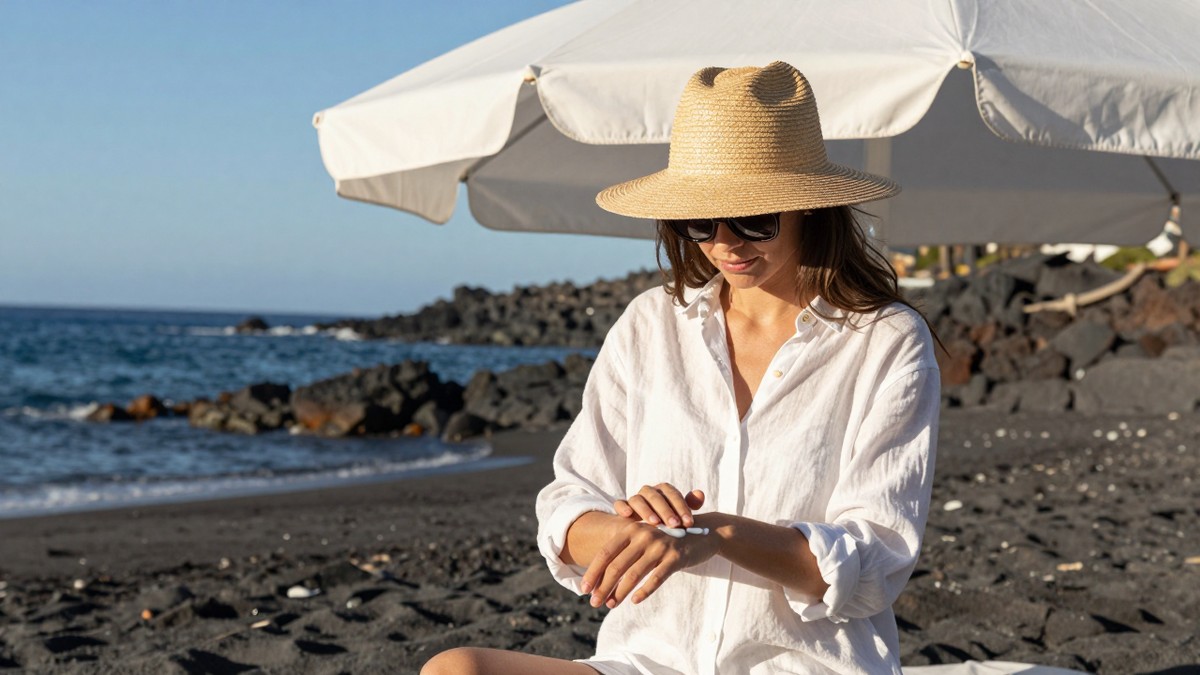
Can I get sunburnt in Tenerife in December UK? Yes. The Met Office advises sunscreen from UV 3, and on our reading of a chart from Spain's weather agency, December's average daily UV peak at Santa Cruz de Tenerife, near sea level, is roughly 3 to 4, higher in the mountains. You can still burn on cloudy, windy or cooler days. Check the UV forecast, not the temperature; use shade, clothing and SPF 30 or more, reapplied every 2 hours and after swimming. Keep babies under 6 months out of direct sunlight.
What to check on the day
The UV index forecast
The Met Office app gives worldwide UV forecasts, including "an hourly forecast for the next 2 days", and the SunSmart Global UV app, co-launched by the World Health Organization (WHO), gives five-day forecasts. The Met Office forecast guide explains the bands:
- 1 or 2 (low): "You can safely stay outside. Consider sunscreen in direct sunlight."
- 3 to 5 (moderate): "Take care during midday hours and do not spend too much time in the sun unprotected. Sunscreen advised."
- 6 or 7 (high): "Seek shade during midday hours, cover up and wear sunscreen."
The travel health service TravelHealthPro says: "Ideally sun exposure should be limited between 11am and 3pm (local time) when the sun is usually at its strongest."
Our suggestion: on a day outdoors, put sunscreen on, and use the hourly forecast to plan shade and cover for the hours it shows 3 or more, whatever the thermometer says. The British Association of Dermatologists (BAD) sets a higher threshold for black and brown skin, covered below.
Why a breeze, a swim or cloud fools you
Cancer Research UK (CRUK) says you can't tell your risk "from the temperature outside. This is because you can't feel UV rays." NHS Inform, Scotland's NHS advice site, says: "The symptoms of sunburn don't usually develop for several hours. This means you may not know you're getting sunburn when you're outside. If there's a breeze or you're swimming outside, this can also cool your skin. This means you may not realise you're getting burnt." It adds: "You can also burn in cloudy and cool conditions."
Shade
A beach umbrella helps less than it looks: BAD says "Beach umbrellas only offer about 3 to 5 times more protection than no shade at all. In this instance, effective sun protection may also involve using sunscreen and/or clothing."
Your skin and medicines
CRUK says take more care if you have skin that burns easily, a lighter skin tone, light coloured hair or eyes, lots of moles or freckles, a history of sunburn, or a personal or family history of skin cancer; the NHS's list also includes anyone "only exposed to intense sun occasionally (for example, while on holiday)".
BAD's sun protection fact sheet recommends sun protection from UV index 3 for white skin and 11+ for black and brown skin. If hyperpigmentation (spots or patches of darker skin) is a concern, it says to follow sun protection advice for the affected area. It also says sun protection is important, even in the UK, for people with black or brown skin who have a skin condition that makes them more vulnerable to sun damage, such as photosensitivity, vitiligo or lupus, or a high risk of skin cancer, especially if taking immunosuppressive treatments (including organ transplant recipients) or genetically predisposed to skin cancer. It adds: "In some countries, the UV Index can be extreme and if you plan on spending a prolonged time outdoors you may wish to follow sun protection advice." With brown or black skin, the NHS says, "you should still avoid burning and take care in the sun as people of all skin tones can get skin cancer".
For black or brown skin, the December figures in this article do not reach BAD's 11+, but CRUK's take-more-care list above includes skin that burns easily and a history of sunburn, whatever your skin tone, and TravelHealthPro's sunscreen advice for travellers does not split by skin tone.
Our suggestion: whatever you take, check each medicine's leaflet for a warning about the sun, and ask a pharmacist before you travel if you are unsure. NHS pages also warn about the sun with benzoyl peroxide, tetracycline antibiotics and isotretinoin, and TravelHealthPro lists more medicines. On tretinoin and adapalene, the NHS says: "It's important to apply topical retinoids sparingly and avoid excessive exposure to sunlight and UV." The NHS pages for doxycycline and lymecycline list "your skin being more sensitive to the sun - causing symptoms such as a rash, itching and redness (this may be harder to see on brown or black skin)" as a possible serious side effect of doxycycline needing urgent advice, and "your skin becomes very sensitive to the sun" as a reason to call a doctor or 111 now on lymecycline (in Tenerife, see When to get help).
No official source we could find covers over-the-counter retinol; our retinol guide suggests pausing it "during a beach holiday where you will be in strong sun for hours at a time" and "for a few days after sunburn while the skin recovers".
 Featured
15% OFF*Limited offer
One Sunday. A week of food, sorted.
23 high-protein recipes, cycle-synced for women who lift.
23 recipes · 60-page PDF · Instant download
£19.20 £16.32
See it on Etsy*Seller's discount on Etsy - may end at any time.
Winter sun in the Canary Islands: the UV index before, during and after December
The Canary Islands public health department says the islands have Spain's highest UV radiation all year round, on data from AEMET, Spain's state weather agency, and that sun protection there has to continue all year, even on cloudy days: daily sunscreen of SPF 30 or more, shade, wide-brimmed hats, clothes that cover arms and legs, and suitable sunglasses.
We could not find an official typical figure for the UV index in Tenerife in December, and AEMET prints no figures for the average line on its chart of daily peak UV at Santa Cruz de Tenerife, 35 metres above sea level, so these are our readings of it:
- November: roughly 3 to 5
- December: roughly 3 to 4, moderate on average; roughly 4 to 5 on its chart for Izaña, 2,371 metres up, where AEMET's reports put each December's highest reading from 2021 to 2025 at between 5.2 and 6.1
- January: roughly 3 to 5
- February: roughly 4 to 7, reaching the high band
The line is an average that includes cloudy days, so some days are higher. We could not find an AEMET UV station in the south of the island, so use the forecast for where you are staying.
What to pack and do
WHO says sun protection "is best achieved by seeking shade and wearing clothes rather than applying sunscreens".
GOV.UK's guidance for visitors says that when you travel to Spain you should have a UK-issued Global Health Insurance Card (GHIC) or European Health Insurance Card (EHIC). GOV.UK's travel insurance guidance says to take "your insurer's emergency assistance telephone number" with you.
1. Check last summer's bottle
Our suggestion: buy new if the best-before date has passed, if you opened it longer ago than the number of months on the open jar symbol, if you cannot remember when you opened it, if it looks, smells or feels different, or if it spent last summer in a beach bag.
An open jar with a number and M shows, the NHS says, "how many months the sunscreen will last once it's been opened". BAD says sunscreens "should be stored in a cool, dry place, out of direct sunlight".
The Cosmetic, Toiletry and Perfumery Association, the industry's UK trade association, says: "Products used extensively on a beach or left open for a length of time should generally be discarded after the holiday period. With correct storage and handling, nearly full packs may be kept until the following season, but small amounts left in the bottom of containers should be discarded." It says to discard a product "if it has become discoloured, has an unpleasant odour or doesn't look like it should". CRUK says: "If it's out of date, it's best to buy a new one."
2. Buy sun cream for Tenerife by the label
The NHS says look for SPF 30 or more with at least 4-star UVA protection, or the letters UVA in a circle, which "indicates that it meets the EU standard", and water-resistant sunscreen if you are likely to sweat or get wet. CRUK advises a lotion, pump spray or roll-on, "not an aerosol".
3. Get it through airport security
GOV.UK's guide to hand luggage at UK airports counts creams and lotions as liquids: "At most airports, you cannot take liquids in containers larger than 100ml through security. This still applies if the container is only part full." It adds: "Some airports may allow you to take liquid in containers that hold up to 2 litres of liquid." Check each airport on your trip, including your return journey.
Our suggestion: with hand luggage only, take sunscreen in containers of 100ml or less and buy more before your first day out, because the NHS puts an adult's whole-body amount at around 6 to 8 teaspoons, about 30 to 40ml (see step 4). Our Altruist Dermatologist Sunscreen SPF 50 review covers a fragrance-free sunscreen sold in packs of two 100ml tubes; the review recommends it for dry-land use and questions its waterproof label.
4. Put on enough, and keep putting it on
The NHS says adults should aim for "around 6 to 8 teaspoons of sunscreen if you're covering your entire body". If you will be out long enough to risk burning, it says apply it 30 minutes before going out and again just before. It says reapply every 2 hours and straight after being in water, "even if it's 'water resistant'", and after towel drying, sweating or when it may have rubbed off; CRUK says once-a-day products need reapplying too.
Sunscreen is not a reason to stay out longer: the NHS says "Do not spend any longer in the sun than you would without sunscreen."
5. Clothes, sunglasses and lips
The NHS suggests a wide-brimmed hat, a long-sleeved top, close-weave trousers or long skirts, and wraparound or wide-armed sunglasses with the CE Mark and British Standard Mark 12312-1:2013 E. For lips, TravelHealthPro says to "Protect lips with sun block".
6. Children and babies
The NHS says: "Babies under 6 months old should be kept out of direct sunlight." It adds: "If you go out when it's hot, attach a parasol or sunshade to your baby's pushchair to keep them out of direct sunlight. Do not cover your baby's pushchair or pram with a blanket because it could lead to overheating." Our suggestion: in Tenerife, use the parasol or sunshade whatever the temperature.
The NHS, CRUK and BAD all put shade and clothing first for babies under 6 months but differ on sunscreen: the NHS does not recommend it and CRUK says it "should not be used", while BAD says avoid it "unless there is no other way to protect them from the sun", when "applying high SPF sunscreen to small areas such as the cheeks and back of the hands is acceptable", but "this should never be solely relied on". From 6 months, the NHS says keep babies out of the sun as much as possible, use SPF 30 or more with UVA and UVB protection, and reapply every 2 hours and immediately after swimming or sweating.
7. Mount Teide
We could not find a published UV reading for the cable car's upper station (3,555 metres) or the summit. WHO says UV levels increase "by approximately 10 per cent" with every 1,000 metres, and that fresh snow "almost doubles a person's UV exposure". Spain's Teide national park page says that in winter it can snow on some days, and the Met Office says snow "can cause sunburn to the underside of your chin and your ears in particular".
The cable car operator tells visitors to "Wear warm clothing, a hat and use sun cream to prevent sunburn" and to "Wear sunglasses to protect yourself from strong sunlight in both winter and summer". It does not let people with heart conditions, pregnant women or children under 3 use the cable car.
TravelHealthPro's Spain page names Teide's peak among places high enough for altitude illness and says: "Where possible travellers should avoid travel from altitudes less than 1,200m to altitudes greater than 3,500m in a single day." Going from the coast to the cable car's upper station (3,555 metres) in one day is that kind of climb, so if you do go, our suggestion is to know the warning signs. On acute mountain sickness (AMS), TravelHealthPro says: "Travellers who develop symptoms of AMS (headache, fatigue, loss of appetite, nausea and sleep disturbance) should avoid further ascent. In the absence of improvement or with progression of symptoms the first response should be to descend."
If someone burns anyway
The NHS sunburn page says sunburnt skin may "feel hot to touch", "feel sore or painful" or "flake or peel - this usually happens a few days after you get sunburn". It adds: "If you have white skin, your skin will usually be red or pink. If you have black or brown skin, you may not notice a change in the colour of your skin." It says sunburn "usually gets better within 7 days" and gives these lists for easing it yourself.
Do:
- get out of the sun as soon as possible
- cool your skin with a cool shower, bath or damp towel (take care not to let a baby or young child get too cold)
- apply aftersun cream or spray, or an unperfumed moisturiser
- avoid alcohol and drink plenty of water to cool down and prevent dehydration
- take painkillers, such as paracetamol or ibuprofen for any pain - follow the instructions in the leaflet
- cover sunburnt skin from direct sunlight until skin has fully healed
Don't:
- do not use petroleum jelly on sunburnt skin
- do not put ice or ice packs on sunburnt skin
- do not pop any blisters
- do not scratch or try to remove peeling skin
- do not wear tight-fitting clothes over sunburnt skin
NHS Inform adds that "aspirin should not be given to children under 16".
When to get help
What counts as serious is the same anywhere, but who you call is not.
In Tenerife
- For a medical emergency, GOV.UK's Spain travel advice says: "Dial 112 and ask for an ambulance." It adds: "Contact your insurance or medical assistance company quickly if you're referred to a medical facility for treatment."
- TravelHealthPro says: "Get prompt medical attention for swollen or blistered skin, chills, a high temperature, dizziness, headaches and feeling sick."
- GOV.UK's guidance for visitors says: "Show your GHIC or EHIC when you visit any state hospital or doctor." The UK government's list of medical providers in Spain shows whether each Tenerife hospital on it is public or private and has English-speaking staff, and says: "None of the service providers are endorsed or recommended by the FCDO."
- The visitor guidance adds: "A GHIC or EHIC covers state healthcare, not private treatment." and "A GHIC or EHIC is not a replacement for travel insurance - it does not cover everything, such as mountain rescue or being flown back to the UK (medical repatriation)." The travel advice warns: "Some hotels may call private doctors or ambulances to take patients to private hospitals. The GHIC or EHIC will not be accepted there."
Signs to act on (NHS lists, UK services)
Our suggestion: in Tenerife, where these lists say GP or 111, go to a state doctor or hospital with your GHIC or EHIC, or ring your insurer's assistance line for advice, and where they say 999, call 112.
The sunburn page says:
Urgent advice: Ask for an urgent GP appointment or get help from NHS 111 if:
You've been out in the sun and:
- your skin is blistered or swollen
- your temperature is very high, or you feel hot, cold or shivery
- you feel very tired, dizzy or sick
- you have a headache
- you have muscle cramps
- your baby or young child has sunburn
Severe sunburn can lead to heat exhaustion and heatstroke, which can be very serious.
Call 111 if you need advice for a child under 5 years old.
The NHS heat exhaustion and heatstroke page says: "Heat exhaustion does not usually need emergency medical help if you can cool down within 30 minutes. If it turns into heatstroke, it needs to be treated as an emergency."
In Tenerife, call 112 instead of 999.
Immediate action required: Call 999 now if:
You or someone else have signs of heatstroke, including:
- still being unwell after 30 minutes of resting in a cool place, being cooled and drinking fluids
- a very high temperature
- hot skin that's not sweating and might look red (this can be harder to see on brown or black skin)
- a fast heartbeat
- fast breathing or shortness of breath
- confusion and lack of coordination
- a seizure or fit
- loss of consciousness
While you wait for help, it says: "Wrap the person in a cool, wet sheet, or fan them or sponge them down with cold water while you wait for help to arrive." It adds: "If they lose consciousness while you're waiting for help, put them in the recovery position and tell the ambulance service. Check their breathing and pulse and carry out CPR if they show no sign of life."
It also says: "Check on children, older people and people with long-term health conditions, such as diabetes or heart problems, as they're more at risk of heat exhaustion or heatstroke."
Frequently asked questions
Can you get a tan in Tenerife in December?
Not safely: the NHS says "There's no safe or healthy way to get a tan. A tan does not protect your skin from the sun's harmful effects."
Does a base tan protect you from sunburn?
A base tan gives very little protection. Cancer Research UK says a base tan "will not protect you from getting sunburnt" and that some studies put a tan's protection at around SPF 3; WHO puts it at "between 2 and 4" and says it "is no defence against long-term UV damage such as skin cancer".
Is SPF 50 better than SPF 30?
SPF 50 gives more protection against UVB, but UK advice sets the minimum at SPF 30. The NHS says 50+ offers "the strongest form of UVB protection", and the British Association of Dermatologists says: "We recommend you choose a sunscreen with an SPF of 30 or above." NHS Inform says: "If you're worried you might not be applying enough sunscreen, you could use a stronger one. For example, SPF50 sunscreen instead of SPF30."
Do I need sunscreen on a cloudy day in Tenerife?
On a day outdoors, yes: the travel health service TravelHealthPro advises SPF 30 or more "even on cloudy days". WHO says cloud generally reduces UV but "light or thin clouds have little effect and may even enhance UV levels because of scattering"; WHO and the Met Office say up to 80% of UV gets through light cloud.
Do children need a different sunscreen?
From 6 months, children need at least SPF 30, like adults, and the NHS does not recommend sunscreen for babies under 6 months, who it says should be kept out of direct sunlight. The NHS says sunscreens made for babies and young children "are less likely to contain additives that might irritate the skin", and the British Association of Dermatologists suggests a fragrance-free one.