
What to do with skin after Halloween makeup: UK removal and recovery
What to do with skin after Halloween makeup in the UK, from the paint coming off that night to the fortnight afterwards, plus the signs that mean a pharmacist, an urgent GP appointment or a hospital.
We earn commission from qualifying Amazon purchases. It costs you nothing and does not affect what we recommend.
Quick answer
Match the remover to the paint. Water-activated palette paint comes off with warm water and mild soap. Cream, grease and long-wear formulas need a cleansing balm, or plain kitchen oil if you own no balm. Then one gentle second cleanse, moisturiser, no scrubbing, no acids or retinol. Weeping, blistering, hot or spreading skin: call 111.
What your skin is telling you right now
Face paint sits on the surface of the skin. Most of what you see the morning after is friction and blocked pores.
Colour that will not shift
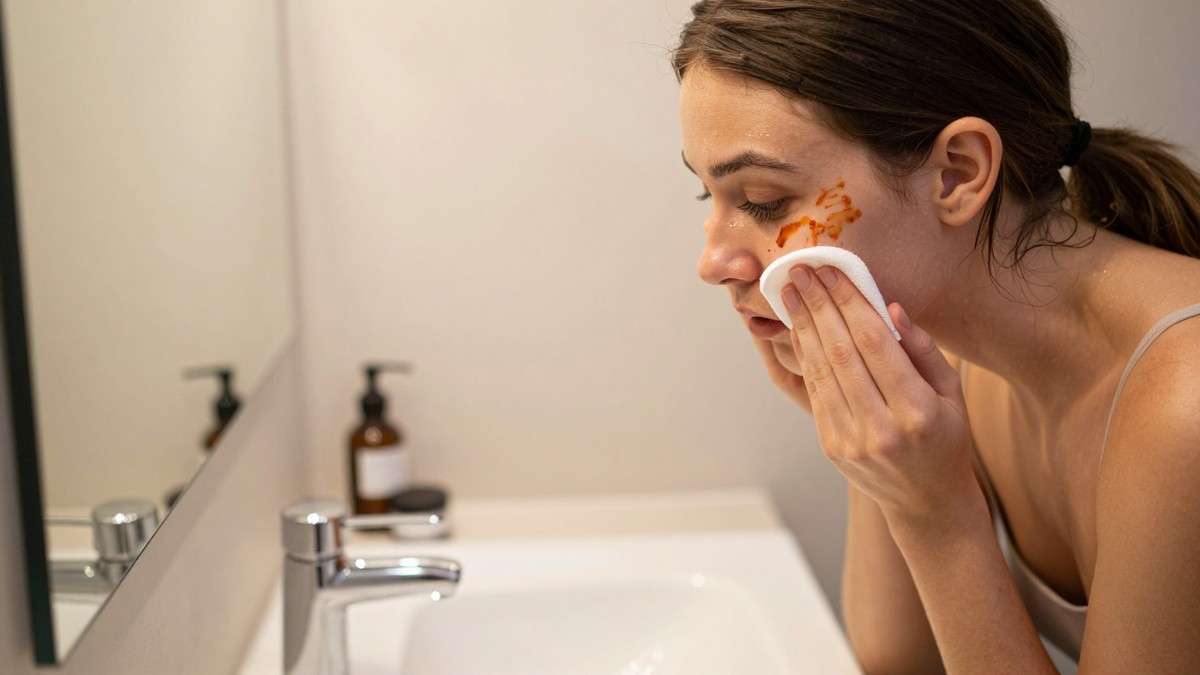
Pigment settles into the fine lines beside the nose, the lip border and the pores of the chin. It reads as a stain when it is really colour sitting in texture, and the right remover for your paint will shift it. Repeat a gentle cleanse tonight and again tomorrow, and put the flannel down: scrubbing costs more than the colour. Reds and deep colours stain worst.
Tight, stinging, faintly shiny skin
Tightness that will not settle, stinging from products that never used to sting and a faint shine is a stripped barrier, usually self-inflicted: four cleanses in a row, hot water, a scrub to finish. The fix is subtraction.
Cleanse twice a day at most, drop every acid and retinol, and keep to fragrance-free basics until a plain moisturiser stops stinging. That is the rule throughout: a few days after one night's damage, up to a fortnight if you were already running acids or retinol.
Small raised bumps where the paint was thickest
Fine bumps following the design, worst where a mask, wig or elastic pressed, are usually blocked follicles: pigment, sweat and hours of occlusion. They appear within a day and fade over several days. What they should not do is itch hard, blister, spread past the paint, or feel hot.
A raised, itchy patch
Deal with heat first. A patch that is painful, hot and swollen is a skin infection: NHS guidance routes that to an urgent GP appointment or 111. Skip the rest of this section.
For a patch that is itchy, dry, cracked or blistered but cool to the touch, think contact dermatitis: the NHS describes skin that becomes itchy, blistered, dry and cracked within a few hours or days of contact, red on lighter skin and dark brown, purple or grey on darker skin. A pharmacist can recommend emollients; see a GP for symptoms that are persistent, recurrent or severe.
Infection is the step people miss. NHS eczema guidance routes blistered, crusty, weeping or pus-filled skin, and skin that is painful, swollen or warm, to an urgent GP appointment or 111. Weeping skin is not something to self-treat.
On a child's face, impetigo is the likely culprit: crusty, golden-brown patches the NHS says look a bit like cornflakes stuck to your skin. It spreads on shared towels, bedding and paint kit. A pharmacist can treat it under Pharmacy First in England from age one, and nursery or school waits 48 hours after treatment starts.
Puffy lids and a gritty eye
Eyelid skin is the thinnest on the face, so it swells first. A gritty feeling usually means a fleck of glitter or dried paint on the eye, and rubbing is the worst response.
A swollen lid is not always mechanical. NHS eyelid guidance sends a lid that is red, hot, painful, tender or blistered, or a suddenly drooping lid, to an urgent GP or optician appointment or 111. Paint goes right around the eye, and the NHS says cellulitis in your eye is very serious. Our own emphasis: do not give a hot, red, swollen lid a day, and a child's is more urgent still.
If you wear contact lenses, take them out first: you cannot rinse a fragment out from under a lens, and it holds the irritant against the eye throughout. Then wash the eye. NHS advice is clean water that is not hot, eye held open, plenty of it over the eyeball for at least 20 minutes, flow kept gentle. Leave lenses and eye makeup off until it is better.
An eye that is very painful, no better after 24 hours, or that worries you means an urgent GP appointment or 111. That 24-hour rule does not apply to lens wearers: NHS red eye guidance sends a lens wearer with a red eye for an urgent appointment or 111 on the redness alone, because it could be an eye infection. Severe pain, changed sight, a headache or light sensitivity, feeling sick or being sick after an eye injury, an eye you cannot move or keep open, or blood or pus means A&E. Never try to remove anything that has pierced the eye.
A crop of spots two or three days later
The delayed breakout lands on the cheeks, jaw and hairline where paint sat thickest and the costume rubbed. NHS acne advice is to wash affected skin no more than twice a day and never to squeeze or clean out spots, because that can scar permanently. A hydrocolloid patch puts a barrier between finger and spot.
If you are dealing with a child's face
Much of the Halloween face paint goes on children, whose skin is thinner, who rub their eyes without thinking and who cannot reliably say if something is sore. Most children's kits are water-activated: warm water, mild soap, a soft flannel used gently, no scrubbing, and more warm water and soap tomorrow for what will not budge.
NHS advice differs by age. 111 online covers anyone aged five and over; always call 111 for a child under five. A child under two with a red eye should be seen by a GP or optician, red eyes in a baby under 28 days old need an urgent appointment, and a child who is limp, floppy or not responding normally is a 999 call.
 Featured
15% OFF*Limited offer
One Sunday. A week of food, sorted.
23 high-protein recipes, cycle-synced for women who lift.
23 recipes · 60-page PDF · Instant download
£19.20 £16.32
See it on Etsy*Seller's discount on Etsy - may end at any time.
How it settles, from that night to a fortnight later
That night, before bed
Get it off, however late. NHS acne advice is explicit that make-up should be completely removed before bed, and Snazaroo says the same of its paint: always remove paint before going to bed. Then stop: no toner, no acid, no retinol, no mask. Moisturiser, then sleep.
Put a clean pillowcase on. Leftover pigment and oil transfer into the cotton and return to your face, feeding the day-two breakout.
The MHRA advises that emollient residue transfers into clothing and bedding, that fabric with dried residue on it ignites easily and burns faster and hotter because the residue acts as an accelerant, and that washing hot reduces the build-up without removing it. That holds for paraffin-based emollients at any strength, and the risk cannot be excluded for paraffin-free ones. Keep that clothing and bedding away from lit pumpkins, candles, sparklers and bonfires.
The next morning
Normal looks like this: slightly pink, a bit tight, pigment left in the pores, perhaps a few bumps. Cleanse once, moisturise, wear sunscreen if you are going out, and leave the rest of the colour for tonight.
Days two and three
This is when bumps and spots arrive, and when a stripped barrier announces itself by stinging at moisturiser. You do not need to buy anything: fragrance-free with glycerin, ceramides, panthenol or plain petroleum jelly will do, and supermarket own-brand is fine. Fragrance, essential oils and exfoliating acids stay in the cupboard until the stinging has gone.
For something made for the job, a panthenol and madecassoside balm is right, which is why La Roche-Posay Cicaplast Baume B5+ belongs here more than in a daily routine. As our review of it notes, it is a thick balm with shea butter, better overnight, and shea can congest breakout-prone skin.
Days four to seven
The quiet stretch, with nothing to do in it. Bumps flatten, tightness fades, the pink goes. Bring one active back once a plain moisturiser has stopped stinging, then the rest one at a time. Marks left by spots run longer, and our guide to fading acne marks says how long.
Still there after a fortnight
An itchy, dry, cracked patch still there after two weeks has stopped being an aftermath and become a condition. NHS guidance is to see a GP for contact dermatitis that is persistent, recurrent or severe, with a referral for further tests if the cause cannot be identified or symptoms are not responding to treatment.
That referral is how an allergy gets named: the British Association of Dermatologists describes patches worn for 48 hours, read when they come off and again at a third appointment, with a reaction occasionally appearing after that final reading.
If it was a reaction, stop using the product and keep the packet: the UK Cosmetics Regulation requires the label to carry the responsible person's name and address, so you have someone to report it to. Serious problems should also reach Trading Standards, through the Citizens Advice consumer helpline on 0808 223 1133; the Office for Product Safety and Standards oversees the regime nationally.
Taking the paint off properly, in order
The order is the whole trick. Almost every bad outcome starts with a wet wipe and pressure.
First, which paint are you wearing?
Water-activated palette paint, the round pans in most children's kits, comes off with water. Snazaroo says its paints are water-based, that warm water and soap will remove them in most cases, and that if scrubbing irritates the skin you should leave it a while.
Cream, grease and stick paint and anything sold as long-wear or waterproof are the oil jobs; liquid latex and prosthetic adhesive need the maker's own remover. Unsure? Wet a small patch: colour that loosens straight away is water-based.
- If water did not shift it, start on dry skin with a cleansing oil or balm. Cream and grease paint is bound with waxes, oils and film formers, so a water-based cleanser only rubs at it. Work in circles until the colour lifts and starts sliding: that change is your cue, and it beats counting seconds.
- Emulsify, then rinse. Add water with your hands still moving until the lot turns milky. Skip it and you leave a waxy film that clogs overnight, the point our micellar water and cleansing balm comparison makes: micellar water alone will not do this job.
- Do the eye area last, and slowly. A bi-phase remover is the right kit for waterproof pigment: its oil layer dissolves what water cannot. Shake it, soak a pad, press it flat against the closed lid and lashes, let it work, then sweep down in one slow stroke. NIVEA Double Effect is the cheap version, and our review covers where it suits sensitive eyes.
- Lift glitter, do not pick it. Press an oiled pad onto the glitter and lift it away, working outwards from the eye, changing pads often. That is for skin and lashes; a fragment on the eye itself gets rinsed and nothing more, with no pad, fingertip or cotton bud. We would not bring sticky tape near an eye socket whatever the internet says.
- Use the proper remover on spirit gum, latex and prosthetics. Use the remover the adhesive maker sells, and never a dry peel: you take skin with it. Liquid latex carries two separate reactions. A true latex allergy is to the rubber proteins, shows within minutes as itching, hives or swelling, and in a small number of cases becomes anaphylaxis, the 999 tier below. Rubber dermatitis is a reaction to the chemicals used to make rubber, a different thing from latex allergy, beginning hours later and peaking at 24 to 48 hours where the latex sat. Never use liquid latex on anyone who has reacted to latex gloves or balloons.
- Go back over the hairline, ears, jaw and neck. That is where the tidemark hides and the next spots start.
- Finish with one gentle second cleanse. Match it to your skin: a non-foaming lotion for dry or sensitive skin, a foaming gel for oily and combination, as our cleanser guide explains. One second cleanse, not three.
If you do not own a balm
Plain kitchen oil does the same job. Sunflower or rapeseed oil, warmed between the hands and worked over dry skin until the colour slides, then washed off with your ordinary face wash or a mild soap. Petroleum jelly works the same way. Neither emulsifies, so skip the milky stage and finish with a wash.
If all you have is soap, water and a towel: one wash with warm water using your hands, pat dry, whatever bland moisturiser is in the house, and leave the rest until tomorrow, when it lifts more easily.
What never to use: nail varnish remover, surgical spirit, white spirit, washing-up liquid or any other solvent from under the sink. None has been assessed for facial skin. Cooking oil and petroleum jelly are exceptions. Very hot water, gritty scrubs and a hard-worked flannel are out too.
Pharmacist, GP, 111 or 999
The mistake people make is routing broken, weeping or infected skin to a pharmacy counter.
Self-care. Mild redness, dryness, tightness or blocked-pore bumps improving day on day. Bland moisturiser, no actives, no scrubbing.
A pharmacist. Contact dermatitis that is simply troubling you, where they can recommend emollients. Mild acne. Impetigo from age one. Antihistamine advice for an itchy hives rash.
A GP appointment. Contact dermatitis that is persistent, recurrent or severe. Acne that over-the-counter treatments have not shifted, or that involves nodules or cysts.
An urgent GP appointment or NHS 111. Skin that is blistered, crusty, leaking fluid or filled with pus; skin that is painful, swollen or warm; anything suddenly worse or bigger. An eyelid that is red, hot, painful, tender or blistered, an eye you cannot open or keep open, or a suddenly drooping lid. A very painful eye, one no better after 24 hours, one that worries you, especially a child's, or a red eye in a contact lens wearer. A hives rash not improving after two days, spreading, or with swelling under the skin. Use 111 online for anyone aged five and over, and call 111 for a child under five.
999 or A&E, immediately. Call 999 if the lips, mouth, throat or tongue suddenly swell; if breathing is very fast or a struggle; if the throat feels tight or swallowing is hard; if skin, tongue or lips turn blue, grey or pale; if someone becomes suddenly confused, drowsy or dizzy; if someone faints and cannot be woken; or if a child is limp, floppy or not responding normally. Those are the NHS signs of anaphylaxis and they need an ambulance.
NHS advice is to use an adrenaline auto-injector first if there is one, then call 999, then lie the person down with legs raised, or raise their shoulders or sit them up slowly if breathing is the problem. Use a second auto-injector if there is no improvement after five minutes. They must not stand or walk, even if they feel better.
Call 999 or go to A&E for infection turning serious too. For cellulitis the NHS lists a very high temperature or feeling hot, cold or shivery; a fast heartbeat or fast breathing; purple patches on the skin, less obvious on brown or black skin; dizziness or feeling faint; confusion or disorientation; cold, clammy or pale skin; unresponsiveness.
Severe eye pain, changed sight, blood or pus from the eye, or an eye you cannot move or keep open belongs here too. NHS advice is not to drive yourself to A&E.
What actually prevents this next time
Patch test the paint you are actually going to wear. A small amount on the inner forearm, a day or two before the costume goes on.
Some UK face paints say to check after an hour, which catches fast reactions only: the NHS puts contact dermatitis at a few hours or days after exposure, and says an allergic reaction can be immediate or delayed depending on the allergy. If you have two days, use them.
Read the packet before you buy. Face paint sold in the UK is a cosmetic product, so the UK Cosmetics Regulation requires a safety assessment and a label carrying the responsible person's name and address, an ingredient list, a batch code and a durability or period-after-opening date.
No ingredient list, no named responsible person with a UK or EU address, or a not-for-cosmetic-use label means put it back; a PO Box or mail-forwarding address is a warning sign too. Paint for under-threes needs its own safety assessment, and since no pack has to state an age range, treat unbranded, unlabelled paint as unsuitable for a toddler.
Nobody shares a pot. Keep pots, sponges, brushes and applicators to one face each. Anyone with a cold sore or eczema gets their own kit: a shared sponge is how a cold sore reaches the next face.
Cosmetic-grade glitter only. The College of Optometrists warns that even one small fragment of non-cosmetic grade glitter may scratch your eye and leave it more open to infection, and advises checking the packaging and the seller's site to confirm the grade. Craft glitter and paint not meant for eyes have no business inside the orbital rim.
Costume contact lenses are a regulated product. Under the Opticians Act 1989, a zero-powered contact lens may only be sold by or under the supervision of a registered medical practitioner, a registered optometrist or a registered dispensing optician.
A costume lens that leaves the eye red, painful, watering, light-sensitive or blurred comes out and gets seen the same day. Never sleep in one.
Assume higher risk if the skin is already unhappy. Eczema, rosacea, acne and any compromised barrier raise the odds, and NHS guidance notes that contact with an irritant can make eczema worse. Our view: if skin is flaring, paint the mask and leave the face bare.
Frequently asked questions
How do I get orange face paint stains off my skin?
Try warm water and mild soap first: most children's face paint is water-based and comes off that way. Cream and grease paint wants a repeat oil or balm cleanse on dry skin, with no scrubbing. The last trace fades with normal skin turnover.
Is it really that bad to sleep in Halloween face paint?
Yes, and it is the choice most likely to cause the breakout three days later. NHS acne advice is to remove make-up completely before bed, and heavy costume pigment against a pillow is far more occlusive than foundation. If you are past that, cleanse properly now; a scrub will not make up for it.
Why has my skin broken out days after wearing face paint?
Because blocked follicles take a couple of days to show. Thick pigment, sweat and something pressing on your face for hours is the whole recipe. Keep to two cleanses a day, do not squeeze anything, and see a pharmacist if mild spots are not settling.
What do I do if glitter gets in my eye?
Do not rub it. Take contact lenses out first, then rinse with plenty of clean water that is not hot for at least 20 minutes, leave lenses and eye makeup off afterwards, and see the eye section above for when this becomes urgent.
How long until my skin looks normal again?
Most people are back to normal within a week: tightness settles in a few days, bumps flatten over the same stretch, and pigment fades alongside. Marks left by spots run to months. Anything itchy, cracked or weeping after a fortnight needs a GP.